Hunting the Twin Quasar near NGC 3079
Resolving Q0957+561, the first confirmed gravitational lens, with a small refractor, a 533-based camera, and a bit of 2x drizzle.
Some targets are impressive because they are bright, detailed, and immediately obvious. Others are impressive because they are barely a few pixels wide, look suspiciously like processing artefacts, and still manage to represent one of the most interesting things you can point a telescope at.
This one is the second kind.
In March 2026, I tried to image Q0957+561, better known as the Twin Quasar or Double Quasar, near NGC 3079 in Ursa Major. It is not visually spectacular in the usual astrophotography sense. No giant spiral arms, no glowing nebula, no dramatic dust lanes.
Just two tiny points of light, separated by roughly six arcseconds, coming from the same quasar.
Which is, frankly, ridiculous.
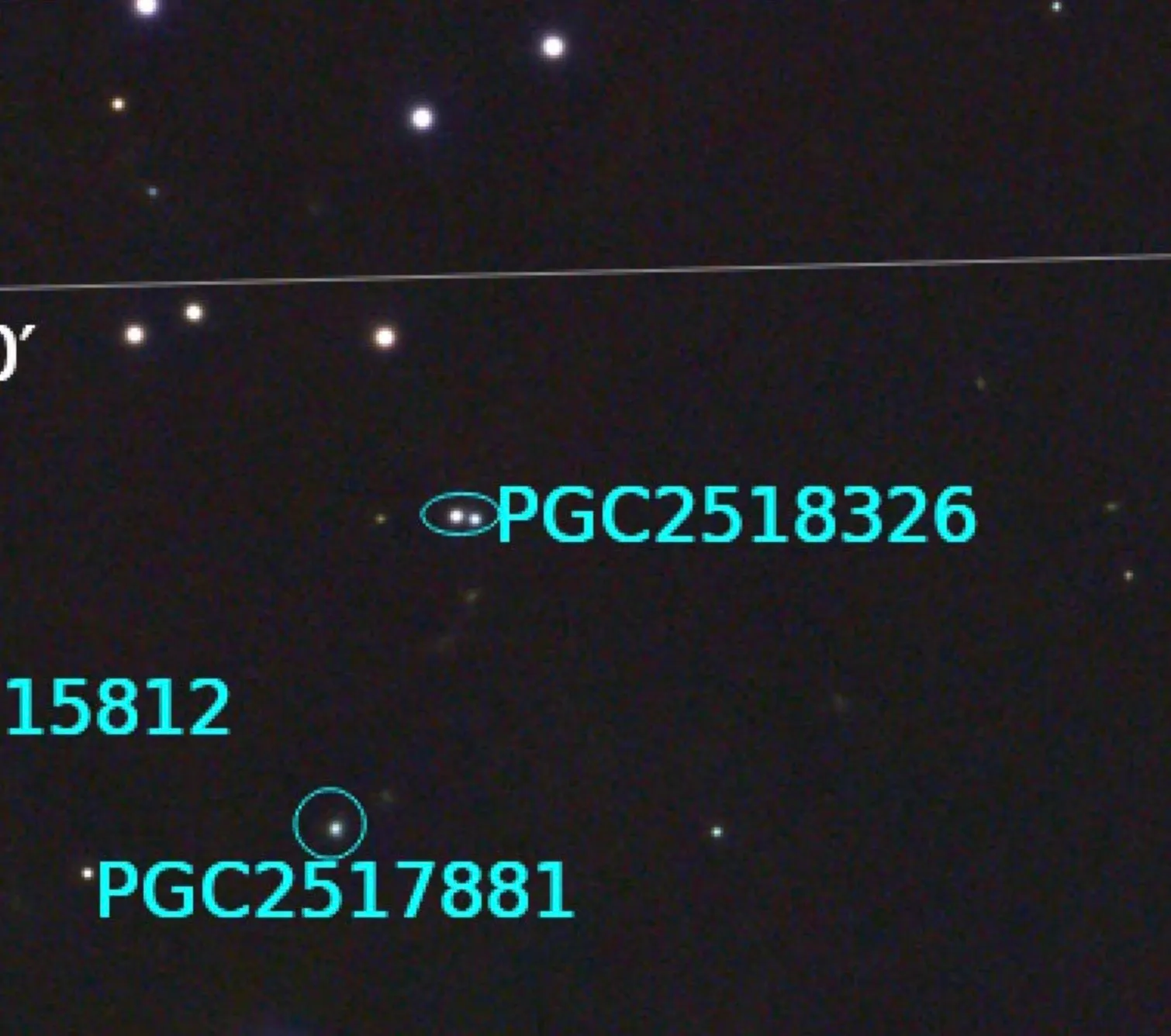
The target: Q0957+561
Q0957+561 is a gravitationally lensed quasar. What we see as two points of light is actually one extremely distant quasar whose light is split into two apparent images by the gravity of a foreground galaxy and its surrounding cluster.
It was discovered in 1979 and became the first confirmed gravitational lens system. The original discovery paper described two magnitude-17 quasar-like sources separated by 5.7 arcseconds.
The common distance quoted for the quasar is about 8.7 billion light-years, with the lensing galaxy much closer to us at around 3.7 billion light-years. As always with cosmological distances, the exact wording matters, but the practical takeaway is simple: this is very, very far away.
And the best part: the two images do not arrive at the same time. Because the light takes different paths around the gravitational lens, one image reaches us roughly 417 days before the other. So when you look at the two dots, you are seeing the same object at two different moments, offset by a little over a year.
Astronomy has a way of making “just two pixels” feel unfairly philosophical.
Why this was not a guaranteed win
My setup for this image was not exactly built for resolving gravitational lenses.
The imaging train:
- 80 mm APO refractor
- 480 mm native focal length
- 0.79× reducer
- Effective focal length: about 379 mm
- 533-based astronomy camera
- Pixel size: 3.76 µm
That gives a pixel scale of roughly:
206.265 × 3.76 / 379 ≈ 2.05 arcseconds per pixelThe quasar images are separated by about 5.7 arcseconds, so on the native image scale the separation is only around:
5.7 / 2.05 ≈ 2.8 pixelsThat is not a lot.
In theory, it is enough to show elongation or maybe a split if the seeing, focus, tracking, sampling, and processing all cooperate. In practice, “if everything cooperates” is doing a lot of work here. This is astrophotography. Something is always slightly wrong, and sometimes that something is the sky.
Drizzle to the rescue
The final image was processed with 2× drizzle, and that helped a lot.
Drizzling is a reconstruction technique originally developed for undersampled astronomical images. The short version is that instead of simply stacking frames onto the same pixel grid, drizzle uses the small natural offsets between individual exposures to reconstruct a higher-resolution output grid.
It does not magically create detail that was never captured. It cannot defeat bad seeing or poor focus. But when the data is undersampled and you have enough frames with slight shifts between them, drizzle can recover spatial information that would otherwise be smeared into the original pixel grid.
With 2× drizzle, my effective image scale becomes roughly:
2.05 / 2 ≈ 1.02 arcseconds per pixelAt that scale, the 5.7 arcsecond separation becomes about 5.6 pixels in the processed image. That is still small, but it is much more workable than 2.8 pixels.
And it seems to have been enough.
The result
The cropped image shows a small but visible separation at the expected position of PGC 251826 / Q0957+561.
It is not a Hubble image. It is not even close. But it is a recognizable detection of the double structure using a small refractor from a home setup, and that is exactly what made this target fun.
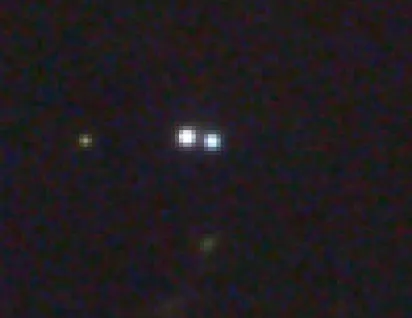
This is one of the things I enjoy most about amateur astrophotography: sometimes the interesting result is not the prettiest image. Sometimes the win is detecting something absurdly distant and physically meaningful with equipment that, on paper, really should not be doing anything that dramatic.
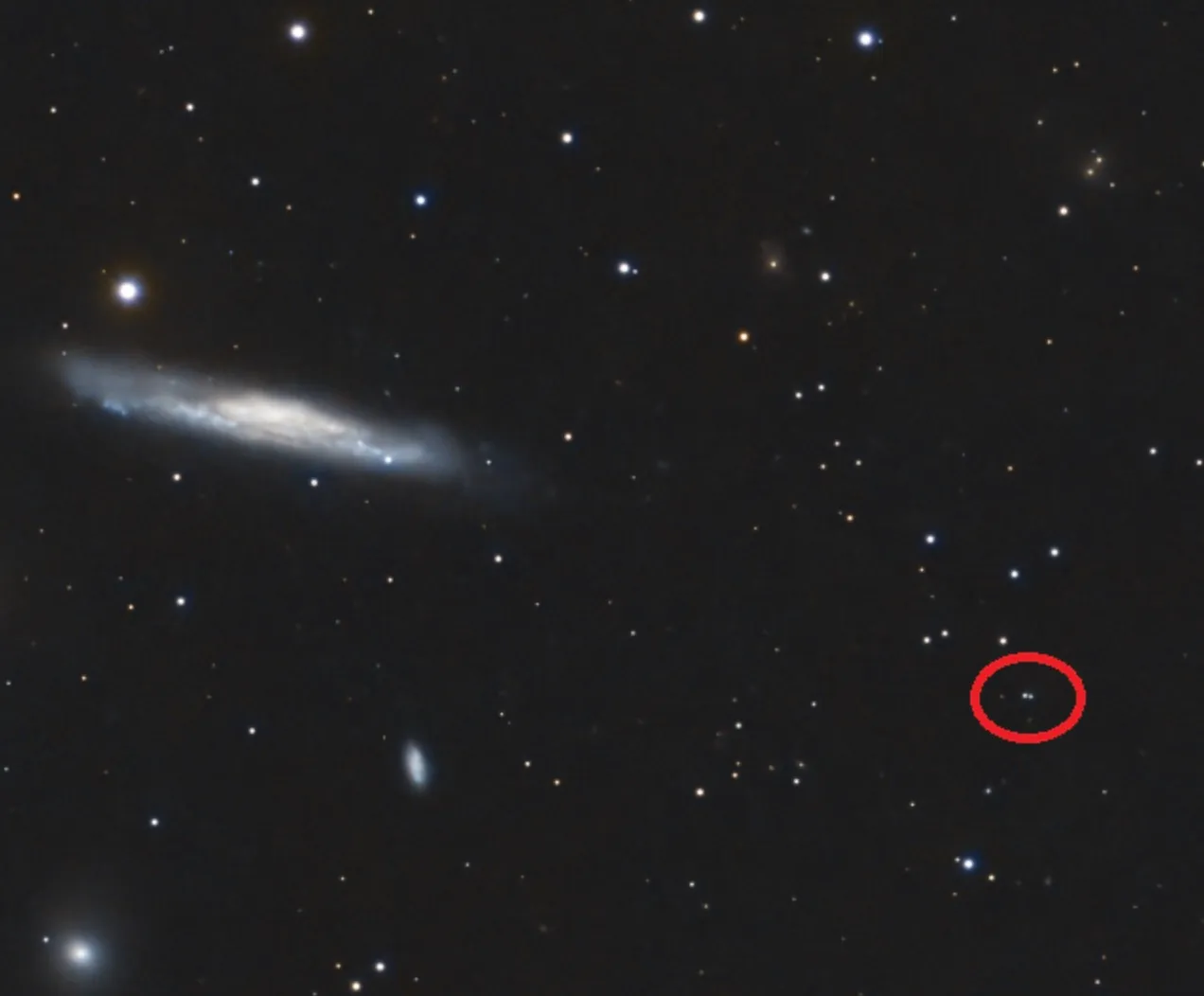
The main galaxy in the wider field, NGC 3079, does provide a nice anchor for the image. It gives the field some visual context, and then the double quasar sits nearby as a tiny reminder that the background universe is not just background.
The science bit, briefly
Gravitational lensing is one of the predictions of general relativity: mass curves spacetime, and light follows that curvature.
In the case of Q0957+561, a massive foreground galaxy and its cluster bend the light from a much more distant quasar. The geometry is just right for Earth to receive two distinct light paths from the same source, so the quasar appears duplicated.
The two images are not perfectly simultaneous. Their light paths have different lengths and pass through different parts of the gravitational potential, which produces the roughly 417-day delay between them.
So this tiny pair of dots is doing several things at once:
- showing a quasar billions of light-years away;
- demonstrating gravitational lensing;
- showing the same object at two different moments in time;
- making me zoom in at 300% and ask whether I am looking at real signal or wishful thinking.
Astrophotography processing is humbling like that.
What I learned
This target was a good reminder that resolution is not only about focal length. Sampling, seeing, focus, tracking, integration time, and processing all matter.
At my native pixel scale, the double quasar was right at the edge of what I expected to separate cleanly. Drizzle did not make the telescope larger, but it did make better use of the data I had. Without it, I think the result would have been much less convincing.
It also reminded me that not every target needs to be framed as a pretty picture. Some targets are interesting because of what they are, not because of how they look.
A faint double point near NGC 3079 is not going to win any aesthetic awards. But it is the first confirmed gravitational lens, a quasar around 8.7 billion light-years away, and two images of the same object separated in arrival time by about 417 days.
That is enough for me.