A Squid, a Bat, and the Last of My Patience
Sh2-129 and Ou4: 43 hours and 35 minutes across fifteen nights, one very faint squid, and a suspiciously sudden interest in monochrome cameras.
There is a Giant Squid inside a Flying Bat in the sky. I decided to photograph both, which sounds like a reasonable thing to do until the squid declines to participate.
This is Sh2-129 and Ou4, captured with a one-shot colour camera and a 7 nm dual narrowband filter. The final image contains 43 hours and 35 minutes of five-minute exposures, collected over fifteen nights.
In the year or so I have been doing astrophotography, this has been my hardest target to capture and process. The processing in particular made me want to pull my hair out.
I am pretty happy with the result. I also now want a monochrome camera.
I had just upgraded from a 533-based camera to a 571-based one. Apparently that was not deep enough into the rabbit hole.
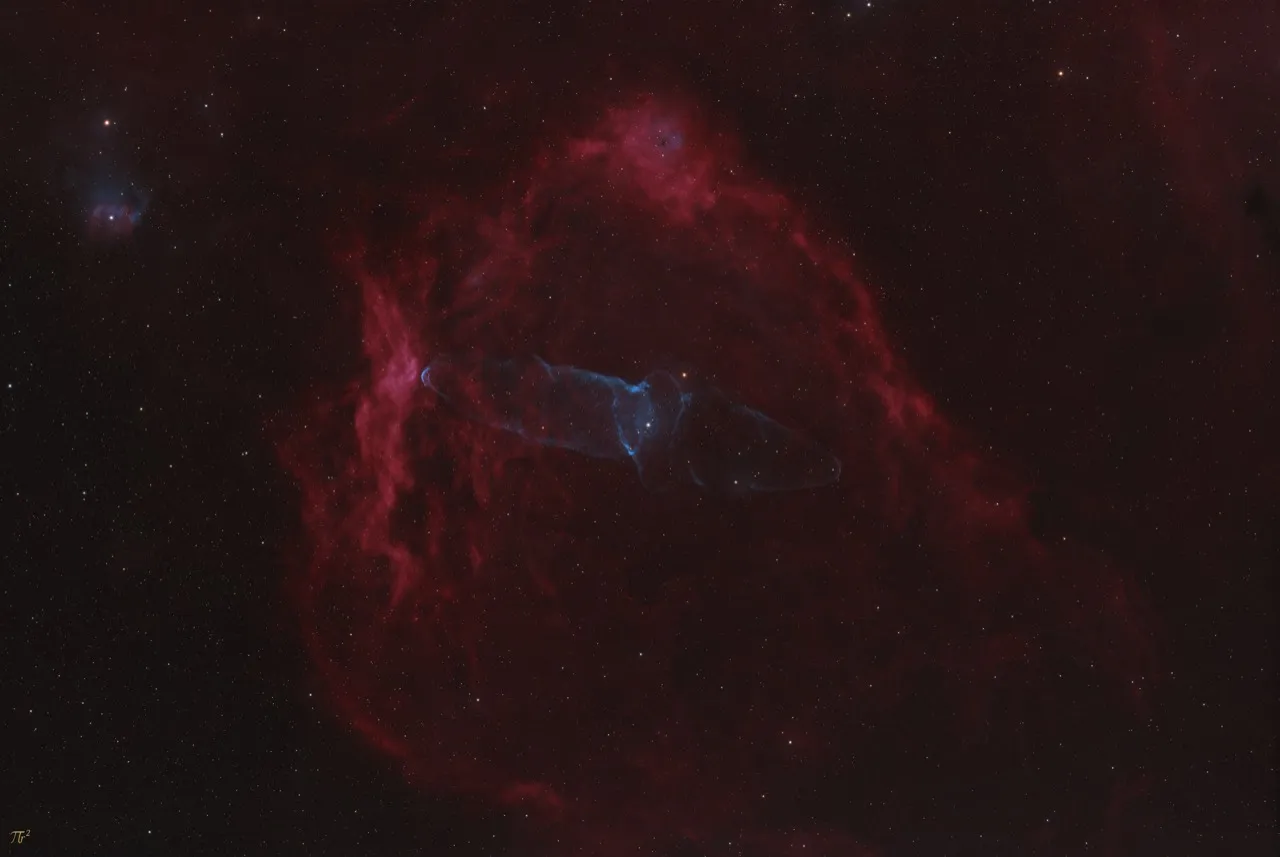
The bat is not the difficult animal
The red emission nebula is Sh2-129, the Flying Bat, in Cepheus. The faint blue-green structure across its centre is Ou4, the Giant Squid. The red glow is associated with hydrogen emission; the squid stands out in emission from doubly ionised oxygen, usually written OIII. NASA’s overview gives some context for the pair.
The difficulty is not that Ou4 is tiny. It is a large structure on the sky, but an extremely faint one. Large and easy are unfortunately unrelated properties.
That is also what makes this field interesting: a broad red nebula, with a much more reluctant structure sitting inside it. I wanted an image where both were visible, not just a red bat with a rumour of seafood.
Fifteen nights for one image
I captured this with a small refractor on a motorised GoTo tracking mount.
The exposure total works out to:
523 × 300 seconds = 43 hours 35 minutesThat is integration time, not the elapsed time spent on the project. Spread over fifteen nights, it is a fairly substantial commitment to one patch of sky.
The dual narrowband filter passes two narrow bands around H-alpha and OIII. With an OSC camera, I collect both in the same exposure rather than shooting separate sessions through individual filters.
That is convenient. It also means every extra five minutes intended to help the faint squid collects more of the hydrogen signal too. The two structures share an image, but they do not make equally easy demands on the processing.
Forty-three hours sounds reassuring when written in the acquisition notes. It does not come with a checkbox labelled “make Ou4 easy”.
Processing: where the hair went
The image was processed in PixInsight, with 2× DrizzleIntegration, followed by BlurXTerminator and StarXTerminator. Separating the stars let me work on the nebula without asking the stars to survive every adjustment aimed at the squid.
The starless image received a GHS stretch, NarrowbandNormalization in HOO, blend mode 2, and curve adjustments. In an HOO palette, hydrogen is mapped to red and oxygen to green and blue. That gives the two structures their useful visual separation.
Useful does not mean effortless.
The hard part was making the faint OIII structure readable without letting the background become the main subject. Stretching faint data is a very effective way to discover that the background has opinions too.
The stars were handled separately with SetiAstro’s NB → RGB Stars script, then screen-blended back into the image. I used SCNR to reduce green and adjusted the red-channel black point to neutralise a remaining red cast in the background.
That last point matters. The bat is supposed to be red. The entire universe around it does not need to join in.
I also enhanced the OIII in Ou4’s filaments and inner glow, separating those structures from the surrounding sky rather than lifting the whole background with them. NoiseXTerminator finished the workflow.
Written as a list of tools, it looks fairly tidy. It is a poor description of how much this target fought me.
The processing was not just about making the image brighter. It was about deciding what to bring forward, what to leave quiet, and when another adjustment was helping the squid rather than merely making a more emphatic background.
The camera upgrade that lasted one target
I had recently moved from a 533 to a 571. A new camera, a larger sensor, and presumably a sensible period of enjoying the equipment I had just bought.
Then I processed this image.
The attraction of mono here is being able to capture H-alpha and OIII separately, and deliberately give the oxygen more exposure time without adding hydrogen at the same time. A monochrome sensor also does not have the colour camera’s Bayer filter array dividing the pixels between colour channels.
That does not mean OSC cannot do this target. The image above is a fairly time-consuming counterexample. It means the experience made the appeal of separate narrowband acquisition much less abstract.
Of course, mono would bring its own filters, a filter wheel, and more acquisition decisions. I would not be buying an end to complexity. I would be choosing a different collection of things to learn.
I have not switched. I am just at the very reasonable stage of wanting a different camera immediately after upgrading my camera.
The rabbit hole is apparently not a hole. It is a construction site. I have brought a shovel.
Still worth it
What I like about the result is that the squid does not completely take over the scene. Its blue-green structure remains faint and delicate inside the much larger red nebula. It is visible, but it still looks like something that needed finding.
That feels appropriate after fifteen nights.
This was the hardest capture and processing project of my first year or so in the hobby. It also produced an image I am happy to have made with my own equipment, and a much clearer idea of why people put themselves through monochrome narrowband workflows.
I pointed a telescope at a bat and a squid. The camera upgrade wishlist was collateral damage.